Why Your Pinterest Traffic Is Dropping (And What You Can Do to Fix It)
Remember when you could log into Pinterest Analytics and see your traffic climbing month after month? Your impressions were up, people were clicking through to your website, and all that time you spent creating pins was finally paying off.
And then one day, you log in and… what happened?!
Your impressions are down, outbound clicks have dropped, and you’re wondering if Pinterest has decided it just doesn’t like you anymore.
Sound familiar?
If you’ve noticed your Pinterest traffic declining lately, you’re definitely not alone. As someone who has worked in Pinterest marketing for over a decade, I’ve watched the platform evolve through more changes than I can count. And yes, I’ve seen traffic fluctuations happen across client accounts, too.
But here’s something important I want you to understand: A drop in Pinterest traffic doesn’t automatically mean your account is failing or that Pinterest is no longer worth your time.
There are several reasons your numbers might be declining, and many of them are things you can actually do something about.
So before you throw your hands up and declare Pinterest officially dead (again), let’s talk about what might be happening and how you can start turning things around.
You’re Not Paying Attention to Seasonal Pinterest Trends
This is one of the biggest things I look at when reviewing Pinterest accounts.
Pinterest is a search and discovery platform, and what people search for changes throughout the year.
For example, let’s say you’re a food blogger whose pumpkin recipes were bringing in tons of traffic during September and October. By January, those same pins probably aren’t going to be getting the same attention.
Does that mean something is wrong with your account? Nope! It means people have moved on to searching for healthy recipes, meal prep ideas, and Valentine’s Day treats.
Pinterest has also confirmed that seasonal trends, holidays, and changing user interests can influence how pins perform.
What you can do: Start using Pinterest Trends to research what people are searching for and when those searches start increasing.
Don’t wait until a holiday arrives to start creating content for it. Pinterest users are planners, and searches for seasonal content often begin months in advance.
One of the things I do with client accounts is plan content around upcoming search trends instead of simply posting whatever happens to be new that week.
A little planning can go a long way toward keeping your content relevant throughout the year.
Your Pinterest Keywords Might Need a Refresh
Let’s talk about Pinterest SEO because, if you’ve read my other posts, you know I’m a big fan.
One mistake I see is businesses using the same keywords over and over without checking whether those phrases still make sense for their content or their audience.
Pinterest search behavior changes, and what people were searching for a few years ago might not be exactly what they’re searching for today.
For example, instead of creating a pin titled “Home Office Ideas,” you might discover that more specific phrases like “Small Home Office Ideas for Apartments” or “Budget Friendly Home Office Organization” are better suited to your content.
The important part is researching those phrases before building your strategy around them.
And please don’t just ask ChatGPT for 100 Pinterest keywords and assume they’re all popular search terms. AI can be helpful for brainstorming, but it doesn’t automatically know what people are currently searching for on Pinterest.
What you can do: Review your pin titles, descriptions, and board descriptions. Make sure you’re using relevant, specific keywords that accurately describe your content.
Use Pinterest search suggestions and Pinterest Trends to explore potential keywords. Then incorporate the most relevant phrases naturally into your content.
No keyword stuffing necessary. We’re marketing a business, not trying to see how many search terms we can squeeze into one sentence.
You’re Creating Pins, but Nobody Has a Reason to Click
This is a big one!
One of the first things I look at when managing a client’s Pinterest account is the relationship between impressions and outbound clicks.
Because while impressions are wonderful, they don’t necessarily mean people are visiting your website.
You could have a pin with thousands of impressions and very few outbound clicks.
Why?
Sometimes the image looks great, but the headline doesn’t give someone a reason to want more information.
Let’s say you’re sharing a blog post about organizing your kitchen pantry.
Your pin says:
“Pantry Organization Ideas”
Not terrible, but not particularly exciting either.
Now imagine that same pin says:
“7 Pantry Organization Tricks That Save Space and Money”
Much better!
You’re giving someone a specific reason to click through and see what you have to say.
What you can do: Take a look at your pins that are getting impressions but very few outbound clicks. Try creating new designs for the same relevant blog posts using stronger, more specific headlines.
Think about the problem your content solves and make that the focus of your pin.
And remember, your landing page needs to deliver what your pin promises. A great headline might earn the click, but valuable content is what makes that click worthwhile.
Your Pin Designs Are Starting to Look a Little Too Familiar
Listen, I love Canva templates as much as the next person. They save time, keep branding consistent, and make creating pins much easier.
But if you’re using the exact same layout, photo, and headline over and over, your content can start blending together.
And with AI making it possible to create hundreds of similar-looking pins, standing out visually is becoming even more important.
Pinterest recommends publishing original content regularly and avoiding repeated uploads of duplicate pins.
That doesn’t mean you need to reinvent your branding every week. It simply means you should create fresh designs and give people something new to look at.
What you can do: Create a handful of Pinterest templates that work with your brand but offer different layouts and headline styles.
Try different photos, colors, text placement, and messaging.
When I work with clients, I pay attention to which designs are performing well and use that information to guide future content creation.
Sometimes something as simple as changing a headline or using a different photo can make a difference.
The key is testing rather than assuming you know what will perform best.
You’ve Stopped Looking at Your Pinterest Analytics
I get it. Analytics aren’t exactly the most exciting part of running a business.
But if you’re creating and publishing Pinterest content without reviewing your results, you’re missing out on some incredibly valuable information.
Pinterest Analytics can tell you which pins are getting attention, which content people are saving, and which pins are actually sending visitors to your website.
And those numbers can tell a story.
For example, if I notice that several pins about one particular topic are driving strong outbound clicks for a client, that’s something I want to explore further.
Maybe there’s an opportunity to create additional content around that subject. Maybe a different headline could attract another audience. Or maybe it’s worth creating fresh pin designs for an existing blog post that’s already performing well.
On the other hand, if something consistently isn’t getting results, I want to understand why.
What you can do: Set aside time each month to review your Pinterest Analytics.
Look at your top-performing pins, outbound clicks, impressions, and the topics people are responding to. Compare your results to previous months, but remember to account for seasonal changes.
Also, make sure you’re comparing the same date ranges and checking whether you’re looking at organic, paid, or combined results.
You don’t need to become a data analyst overnight. Just start paying attention to the patterns.
And if your numbers are down for a week? Don’t panic. Pinterest content can continue gaining traction long after it’s published.
There Might Be a Technical Problem You’re Overlooking
Here’s something that doesn’t get talked about nearly enough.
Sometimes declining Pinterest traffic has less to do with your pin designs or keywords and more to do with what’s happening on your website.
Broken links, slow-loading pages, and problems with Pinterest accessing your website can all create issues.
Pinterest specifically recommends checking your links, website speed, and whether Pinterestbot can access your content when troubleshooting declining performance.
What you can do: Click through a few of your own pins and make sure they’re taking visitors to the correct pages.
Check that your website loads properly on mobile, verify that your website is claimed in Pinterest, and make sure you haven’t accidentally changed or removed pages that your popular pins link to.
It’s also worth checking your website analytics to see whether the traffic decline appears there, too.
Because sometimes the problem isn’t that Pinterest stopped showing your content. It’s that something along the way isn’t working the way it should.
And wouldn’t it be nice if every Pinterest traffic problem could be fixed by correcting one broken link?
We can dream.
So, How Do You Start Getting Your Pinterest Traffic Back?
If your Pinterest traffic has been dropping, my biggest recommendation is not to panic and completely overhaul everything overnight.
Instead, start with a little detective work.
Look at your analytics. Identify which topics and pins have lost traffic. Check for seasonal patterns. Refresh your keyword research. Create new pin designs for content that still has value, and make sure your website isn’t creating problems behind the scenes.
Most importantly, stop treating Pinterest like a platform where you can simply schedule content and forget about it.
Pinterest marketing works best when there’s an actual strategy behind what you’re publishing.
And that strategy should change as your audience, your content, and the platform evolve.
Need Help Figuring Out What’s Happening With Your Pinterest Traffic?
Here’s something I’ve learned after more than a decade managing Pinterest accounts: Creating pins is only one small part of successful Pinterest marketing.
The real work is understanding why something is performing well, why something else isn’t, and what changes might help move an account in the right direction.
That’s a big part of what I do for my clients.
When I take over a Pinterest account, I’m not just uploading pins and calling it a day. I’m digging into the analytics, researching keywords, reviewing existing content, identifying opportunities, and building a strategy around that specific business.
I look at which blog posts or products have the most potential, which topics are bringing in traffic, how seasonal trends might affect performance, and where we can make improvements.
From there, I handle the ongoing work of creating fresh, SEO-optimized pins, scheduling content consistently, tracking performance, and making adjustments as we learn what works.
Because honestly, running a business is already enough work without having to spend your evenings trying to figure out why Pinterest suddenly decided your most popular pin from last month isn’t getting any attention.
I’m currently accepting new clients for monthly Pinterest management, and I’d love to help you take the guesswork out of your Pinterest strategy.
Whether your traffic has been declining, your account has become stagnant, or you simply don’t have the time to give Pinterest the attention it needs, my goal is to help you build a more intentional strategy that gets your content discovered and drives meaningful traffic to your website.
And while there’s no magic button that guarantees Pinterest traffic (believe me, if I found one, I’d let you know!), having someone consistently monitoring your account, analyzing results, and making strategic adjustments can make a real difference.
If you’re ready to stop guessing and start approaching Pinterest with a plan, let’s chat about how my monthly Pinterest management services can help your business grow. LEARN MORE HERE
Because Pinterest traffic might fluctuate, but your marketing strategy shouldn’t be left to chance.
Pinterest Marketing in the Age of AI: How to Get Your Content Seen
Remember when creating a pretty Pinterest pin, adding a few good keywords, and posting consistently was enough to start seeing traffic roll in? Ah, the good old days.
Fast forward to 2026, and Pinterest looks a little different. Artificial intelligence has officially entered the chat, and apparently, it brought about 10,000 perfectly styled Pinterest pins with it.
AI-generated images, automated content creation, and tools that can produce dozens of pins in minutes have completely changed the content creation game. And while I’m certainly not against AI (trust me, I use it too!), there is something we need to talk about.
When everyone can create beautiful content in seconds, how do you make YOUR content stand out?
After more than a decade working in Pinterest marketing, I’ve watched this platform go through plenty of changes. And while AI has definitely added a new challenge, I don’t believe it’s the end of organic Pinterest traffic.
I do, however, think it’s time to be a little more strategic about how we’re using Pinterest to market our content.
So, let’s talk about what’s changing, what still works, and how to make sure your content isn’t getting buried under a mountain of AI-generated pins.
Pinterest Is Paying Attention to AI Content, and You Should Be Too
If you’ve been scrolling Pinterest lately, you’ve probably noticed just how much AI-generated content is popping up.
Perfectly decorated homes that don’t actually exist, recipes featuring food that looks almost too perfect, and enough AI-generated lifestyle photography to make you question whether anyone owns a real camera anymore.
And Pinterest is noticing, too.
Pinterest has introduced labels identifying content that may have been created or modified using AI. They’ve also given users more control over how much AI-generated content they want to see in their feeds and continue to take action against spammy, low-quality content.
Now, that doesn’t mean Pinterest is automatically removing every AI-generated pin. But it does show that the platform recognizes the need to address AI content and maintain a useful experience for its users.
And here’s where I think content creators have a real opportunity.
Instead of trying to compete with AI by producing MORE content, focus on creating BETTER content.
I’d much rather create an original pin in Canva using real photography, intentional design, and well-researched keywords than generate 20 nearly identical AI pins and hope something sticks.
Does that mean a Canva-designed pin automatically performs better than an AI-generated pin? Of course not. But original, thoughtful content gives you the opportunity to create something unique to your business.
And when everyone else is starting to look the same, being different is a pretty good thing.
Pinterest SEO Still Matters (A LOT!)
If you’ve followed me for any amount of time, you know I love talking about Pinterest SEO.
And guess what? AI hasn’t changed that.
Pinterest is a visual search and discovery platform. People are searching for ideas, products, inspiration, and solutions. If you want your content to show up in those searches, you need to understand what people are actually looking for.
For example, instead of creating a pin titled “Living Room Ideas,” try something more specific like “Small Living Room Decorating Ideas on a Budget.”
See the difference?
The second title speaks directly to someone searching for a particular solution.
I spend a lot of time researching keywords for my clients, watching Pinterest Trends, and identifying seasonal opportunities before creating their content.
And here’s something important: Just because ChatGPT suggests a keyword doesn’t mean people are actually searching for it on Pinterest.
AI can be helpful for brainstorming, but keyword research still needs a human touch.
Give People a Reason to Click, Not Just Scroll
One of the biggest things I focus on when managing Pinterest accounts is the difference between impressions and outbound clicks.
Don’t get me wrong, impressions are great! We love seeing those numbers climb.
But if your goal is getting people to your blog, online store, or website, those outbound clicks are what really matter.
A pin can get thousands of impressions and still send very little traffic to your website.
Why? Because pretty doesn’t always mean clickable.
Instead of a pin that simply says “Pantry Organization,” try something like “10 Pantry Organization Tricks That Actually Save Space.”
Now you’re giving someone a reason to click.
Your pin should grab attention, address something your audience cares about, and make them want to learn more.
Because at the end of the day, we’re not just trying to decorate someone’s Pinterest feed. We’re trying to market a business!
Why Having a Human Behind Your Pinterest Strategy Matters More Than Ever
This is something I’ve been paying particularly close attention to with the client accounts I manage.
With AI making it easier than ever to create content, I think the biggest advantage businesses have right now is a strategy that isn’t completely automated.
When I manage a Pinterest account, I’m not simply creating pins and scheduling them. There’s a lot happening behind the scenes that people don’t necessarily see.
I’m researching what that specific audience is searching for, identifying content opportunities, analyzing which pins are driving traffic, watching seasonal trends, and making adjustments based on what’s actually working.
If a certain blog post is getting strong outbound clicks, I want to know why. Was it the headline? The topic? The image? The timing?
Then I use that information to guide what we create next.
And when something isn’t working, I change it. Because sometimes a pin you think is going to be amazing does absolutely nothing. Pinterest likes to keep us humble like that.
I also prefer working with original photography and thoughtfully designed Canva pins whenever possible. Not because AI imagery can’t perform, but because I want my clients’ content to feel authentic, recognizable, and different from the hundreds of similar images people are scrolling past.
That’s the difference between simply producing Pinterest content and actually managing a Pinterest marketing strategy.
AI can generate images, write descriptions, and suggest headlines in seconds. What it can’t replace is the experience, creativity, ongoing attention, and personal judgment that go into understanding an individual business and its goals.
And after more than a decade in Pinterest marketing, I’ve learned that those little strategic decisions can make a big difference.
Here is an account I took over for a new client and these were the results after just ONE MONTH of me pinning.
Don’t Overlook the Power of a Small Pinterest Ad Budget
Here’s something I think more bloggers and business owners should be considering, especially with how competitive Pinterest has become.
You don’t necessarily need a huge advertising budget to give your content an extra boost.
In fact, even a small, carefully planned Pinterest ad campaign can help you get your content in front of new audiences and test what resonates.
And when I say small, I really do mean small.
You can start experimenting with something like $2 a day.
The important part is knowing which pins are worth promoting, who you’re targeting, and what you’re hoping to accomplish.
Simply throwing money at a pin and hoping Pinterest works its magic isn’t exactly a strategy. Although wouldn’t that be nice?
I always recommend taking a strategic approach to advertising, especially when you’re working with a limited budget. Start with content that’s already showing promise organically, test your targeting, and pay attention to your results before increasing your spending.
Small budgets don’t guarantee big results, but they can give you useful information without requiring a massive investment.
And because I know Pinterest advertising can feel a little intimidating, I’ve put together a FREE Pinterest Ad Strategy Guide to help you better understand how to approach Pinterest advertising, even when you’re working with a smaller budget.
So, Can You Still Get Traffic From Pinterest in the Age of AI?
Absolutely!
But I think the days of creating random pins, tossing in a few keywords, and hoping for the best are becoming less forgiving.
Pinterest marketing requires a more intentional approach. That means understanding your audience, creating original content, using Pinterest SEO strategically, and paying attention to what your analytics are telling you.
And while AI can absolutely help make parts of the process easier, I don’t believe it should replace the actual strategy behind your marketing.
You don’t need to compete with AI by producing more content than a machine.
Spoiler alert: You’re probably not going to win that competition.
Instead, focus on creating content that’s actually worth noticing.
Need Help Getting Your Content Seen on Pinterest? Let’s Work Together!
If you’re feeling overwhelmed trying to keep up with Pinterest, you’re definitely not alone.
Between creating fresh pins, researching keywords, scheduling content, analyzing results, and keeping up with platform changes, Pinterest marketing can quickly become another full-time job.
And I’m guessing you already have enough on your plate!
I’m currently accepting new clients for monthly Pinterest management, and I’d love to help you build a strategy that gets your content in front of the right audience.
With over a decade of experience managing Pinterest accounts for bloggers, content creators, and businesses, I know there’s a lot more to successful Pinterest marketing than simply publishing pins.
My monthly management services focus on strategic keyword research, original pin creation, Pinterest SEO, consistent scheduling, performance tracking, and making ongoing adjustments to help improve visibility and drive meaningful website traffic.
I can also help you explore Pinterest advertising opportunities if you’re interested in putting a small budget behind your content.
My goal is simple: Take Pinterest marketing off your plate while creating a strategy that helps your content get discovered by the people who are actually looking for it.
If you’re ready to stop guessing and start taking a more strategic approach to Pinterest, I’d love to chat about how my monthly management services can help your business grow.
The Ultimate Guide to Preparing for Pinterest’s Busy Season
If you’re waiting until October to start thinking about your fall and holiday Pinterest strategy, I have some unfortunate news: Pinterest has already mentally decorated for Christmas, and they started in July.
Pinterest users are planners. They’re searching for ideas, saving inspiration, comparing products, and figuring out what they want to make, buy, try, or do well before the actual season arrives.
That means your Pinterest strategy needs to be ready before your customers are officially in fall and holiday mode.
And whether you’re a blogger, content creator, product based business, or service provider, this matters. Fall and the holiday season can bring a huge opportunity to get your content, products, and offers in front of people who are actively searching for what they need next.
But a successful busy season on Pinterest isn’t just about throwing a few pumpkin graphics into Canva, scheduling some holiday Pins, and hoping Pinterest takes it from there.
There’s some prep work involved.
You need to know what your audience is searching for, which of your existing content deserves another push, what new content or offers you need to create, how to properly optimize everything for Pinterest SEO, and when your Pins should actually start going out.
And ideally, you want to do all of that before the rest of your business enters its own version of holiday chaos.
Because once orders pick up, promotions start, client work gets busier, and your personal calendar somehow develops a life of its own, “work on Pinterest” has a funny way of sliding straight to the bottom of the to do list.
So, let’s make sure that doesn’t happen.
In this guide, I’m going to walk you through how to prepare your Pinterest account and strategy for the fall and holiday busy season so you can head into it with a plan instead of realizing halfway through November that you probably should have started two months ago.
But First, If You’re New Here…
Welcome! I’m Megan, a Pinterest Marketing Expert and educator.
I’ve taught more than 9,000 students how to use Pinterest strategically to grow their traffic and businesses, and I’ve had the opportunity to work on Pinterest strategy with everyone from bloggers and small business owners to major brands like Target, The Home Depot, Lowe’s, and Sephora.
In other words, I’ve spent a lot of time in the Pinterest world. Over a decade to be exact.
I’ve seen what works, what doesn’t, and what happens when businesses treat Pinterest as an actual marketing strategy instead of something they occasionally remember exists.
So when I tell you that preparing early for Pinterest busy season matters, I’m not just saying it because it makes for a good blog post.
I’ve seen firsthand what the right Pinterest strategy, SEO, content, consistency, and timing can do for a business.
Now, let’s get yours ready for busy season.
Pinterest Busy Season Starts Earlier Than You Think
One of the biggest mistakes businesses make with seasonal Pinterest marketing is waiting until the season arrives to start promoting it.
On Pinterest, that’s usually too late.
Pinterest is a visual search and discovery platform, and people use it to plan ahead. They’re searching for fall recipes before the weather cools down, saving Halloween ideas before October, planning Thanksgiving menus weeks in advance, and looking for Christmas gifts long before December.
Your content needs to meet people while they’re planning, not just when the holiday arrives.
That’s why I recommend thinking several weeks, and sometimes months, ahead with your seasonal Pinterest strategy.
Start thinking about what’s coming up in your business:
• Fall content
• Halloween
• Thanksgiving
• Black Friday and Cyber Monday
• Christmas and holiday shopping
• New Year content and offers
You don’t need every Pin designed months in advance, but you should know what you want to promote and when you need to start promoting it.
The goal is to avoid looking at the calendar on November 20th and thinking, Oh right. Pinterest.
Look at What Worked Last Year
Before creating a mountain of new content, open your Pinterest analytics and see what you already know.
Which seasonal Pins performed well last year? What drove clicks? Which topics got saves? Did a particular blog post, product, or offer perform better than expected?
Look at things like:
• Top performing seasonal Pins
• Content that generated outbound clicks
• Seasonal topics that performed well
• Products or offers that received Pinterest traffic
• Older content that could be promoted again
And don’t immediately dismiss a Pin because the design looks a little… 2022.
If the topic performed well, that’s valuable information.
You can update the content, create fresh Pin designs, test new headlines, and give that URL another chance to perform.
You don’t need to guess your entire busy season strategy when you already have data telling you what people responded to.
Map Out Your Seasonal Content
Next, decide what you actually want to promote.
And no, everything you create between August and December does not need a pumpkin strategically placed in the corner.
Think about what your audience will be searching for during this season and where your business fits.
If you’re a blogger or content creator, this could mean seasonal recipes, decorating ideas, gift guides, holiday activities, travel content, budgeting tips, party ideas, or other content that naturally fits the season.
If you run a product based business, think about your giftable products, seasonal collections, Black Friday offers, and products that solve specific holiday needs.
And if you’re a service provider, you don’t get to skip this part.
Your ideal clients still have seasonal needs. They may be planning for Q4, trying to hit year end goals, preparing their businesses for the holidays, or already thinking ahead to the New Year.
Once you identify your opportunities, put them on a content calendar and work backward from when people will be searching for them.
If you want something gaining traction in November, don’t wait until November to start publishing it. August/September would be the time to post.
Your future self, who is trying to answer emails, manage clients, run a promotion, and somehow attend three holiday events in one week, will thank you.
Make Sure You Understand Pinterest SEO in 2026
This is a big one.
You can create the prettiest Pins in the world, have an amazing offer, and publish incredible content, but if Pinterest doesn’t understand what that content is about, you’re going to have a much harder time getting it seen.
Proper Pinterest SEO in 2026 matters. SO MANY people are still using improper SEO, from their account to their pins.
Pinterest SEO isn’t just adding a keyword to your Pin description and calling it a day.
Your Pinterest account itself needs to be properly optimized.
Your profile, boards, board titles, descriptions, content, and overall strategy should send Pinterest clear signals about your niche and the topics you create content around. If they aren’t then your content has no chance of ever ranking.
Then your individual content needs to be optimized around what your audience is actually searching for.
Pay attention to:
• Pinterest search suggestions
• Related searches and topics
• Pinterest Trends
• Seasonal keyword variations
• Search intent
Search intent is especially important.
Don’t just ask, What keyword can I use?
Ask, What does this person actually want when they search for this?
Seasonal search behavior changes as we move through fall and the holidays, so your keyword strategy should change with it.
And please don’t find 37 vaguely related keywords and stuff them all into one description.
We left keyword stuffing behind for a reason.
If your account isn’t optimized properly and your content isn’t sending Pinterest the right signals, you can spend hours creating and scheduling content that has very little chance of reaching the people you created it for.
That’s a lot of work just to hear crickets.
Refresh What You Already Have
Preparing for busy season doesn’t mean you need to create everything from scratch.
Go through your existing seasonal blog posts, products, landing pages, lead magnets, and offers.
Ask yourself:
Is this still relevant, accurate, and worth sending Pinterest traffic to?
Update outdated information, fix broken links, check product availability, improve your calls to action, and revisit your Pinterest SEO.
Then create fresh Pins for the content that’s still relevant.
You can experiment with different images, headlines, designs, calls to action, and keyword angles.
For example, one holiday gift guide could potentially be positioned around several searches:
• Christmas gift ideas for mom
• Gifts for women who have everything
• Holiday gifts under $50
• Unique Christmas gift ideas
Same content. Different search intent.
Think fresh creative, not necessarily fresh content.
And seriously, check your links.
There is nothing more painful than getting someone to click your Pin only to send them to an expired offer or a product you stopped selling six months ago.
Create and Schedule Your Seasonal Pins Early
Once you know what you’re promoting and which keywords you’re targeting, start creating your Pins.
And please don’t wait until the week before Thanksgiving to open Canva and suddenly decide it’s time to become a Pinterest content machine.
For your priority seasonal content, products, and offers, create multiple Pin designs so you can experiment with different headlines, images, designs, calls to action, and search angles.
Your Pin should make it immediately clear what someone will get when they click.
Pinterest users are scrolling through a lot of content.
Clear beats clever.
Then get those Pins scheduled.
You want a consistent flow of optimized content going out throughout the season rather than publishing whenever you happen to find five spare minutes. The more consistent you are with pinning (at least one fresh pin a day) the more the algorithm will favor your content, and rank it higher.
Because once busy season arrives, those spare five minutes become suspiciously difficult to find.
Scheduling ahead also gives you more time to pay attention to what’s actually happening with your account.
Which Pins are getting clicks? Which topics are gaining traction? Is something performing better than expected? Is there an opportunity you should be taking advantage of?
Pinterest strategy shouldn’t be schedule it and forget it.
Your data should help determine what you do next.
The goal is to enter busy season with Pinterest already working, not with Pinterest sitting on your to do list.
Which brings me to something important…
Why Hiring a Pinterest Strategist Is One of the Best Moves You Can Make for Your Business
At this point, you might be looking at everything we’ve covered and thinking, Okay Megan, when exactly am I supposed to do all of this?
Fair question.
Because Pinterest management involves a lot more than making pretty graphics and hitting publish.
There’s strategy, keyword research, Pinterest SEO, content planning, Pin design, scheduling, analytics, testing, and optimization.
And somehow you’re supposed to do all of that while also running your actual business.
This is exactly why hiring a Pinterest strategist can be such a valuable investment.
Pinterest Management Is More Than Just Pinning
When I manage a Pinterest account, I’m not simply creating Pins and checking Pinterest off the to do list.
There is a strategy behind what gets published.
I’m researching keywords. I’m making sure the account and content are properly optimized. I’m looking at the data. I’m watching what people are responding to. And I’m using that information to make strategic decisions about what we do next.
When all of those pieces start working together consistently, the results can be pretty exciting.
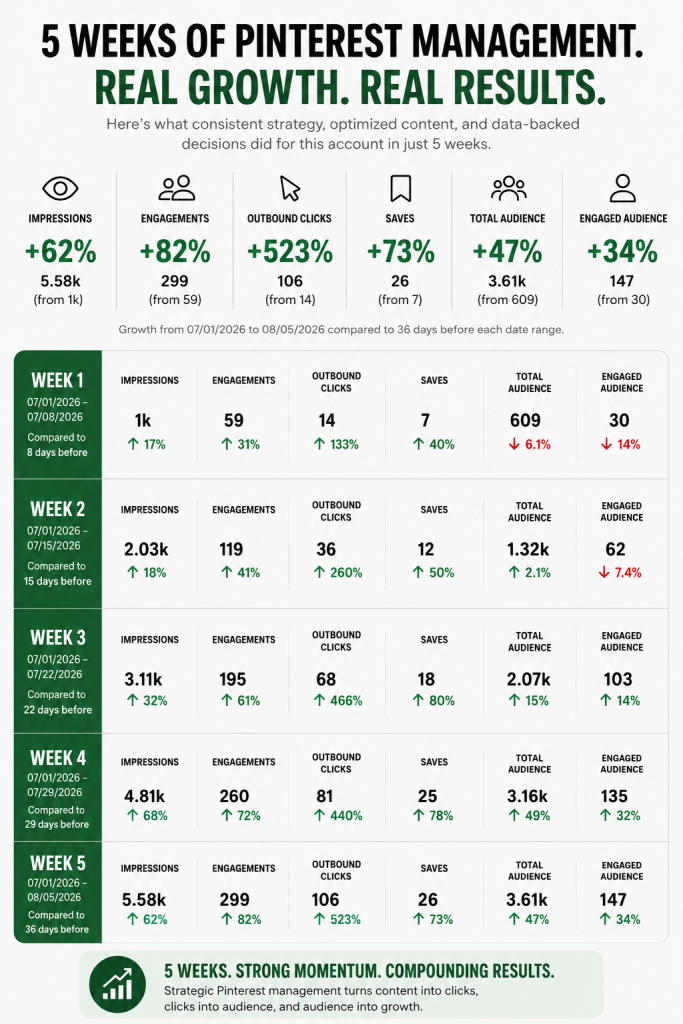
Here’s a real example from one account after just five weeks of Pinterest management:
• Impressions increased 62%, from 1K to 5.58K
• Engagements increased 82%, from 59 to 299
• Outbound clicks increased 523%, from 14 to 106
• Saves increased 73%, from 7 to 26
• Total audience increased 47%, from 609 to 3.61K
• Engaged audience increased 34%, from 30 to 147
In five weeks.
And personally, that 523% increase in outbound clicks is one of my favorite numbers on this report.
Because impressions are great. Of course I want people seeing your content.
But I don’t just want people seeing your Pins.
I want them clicking.
I want them going to your website, reading your content, discovering your products, joining your email list, and learning about your offers.
That’s where Pinterest becomes more than another platform you feel obligated to keep up with.
It becomes part of your overall marketing strategy.
And those results didn’t happen because we randomly published more Pins and crossed our fingers.
They came from consistent strategy, optimized content, and decisions based on actual data.
That’s the difference between simply having a Pinterest account and having someone actively strategizing how Pinterest can support your business.
You Don’t Have to Do Pinterest Yourself
You know what needs to happen before busy season now.
But knowing what to do and actually having the time to execute it consistently are two very different things.
That’s where I come in.
My Pinterest VA services are designed to take Pinterest off your plate without taking the strategy out of it.
Instead of spending your busy season researching keywords, designing Pins, optimizing content, scheduling, analyzing results, and wondering whether you’re doing any of it correctly, you can focus on the parts of your business that actually need you.
Meanwhile, Pinterest keeps moving behind the scenes.
Because your business doesn’t need someone who simply “pins for you.”
It needs someone who understands Pinterest.
Someone who understands Pinterest SEO in 2026, knows how to research your audience and keywords, can create strategic content, watches your analytics, and knows how to use that information to determine the next move.
If you’ve been telling yourself you’ll get serious about Pinterest when you have more time, I hate to be the bearer of bad news…
Busy season probably isn’t going to magically give you more of it.
So instead of adding Pinterest to an already overflowing fall and holiday to do list, let me take it off your hands.
Ready to Get Pinterest Off Your To Do List?
If you want Pinterest working for your business this busy season without having to manage every keyword, Pin, schedule, and analytics report yourself, I’d love to help.
The Real Cost of DIY Pinterest: Is Hiring a Pinterest Strategist Actually Worth It?
Have you ever looked at the price of Pinterest management and thought, “Oof… I could just do it myself.” 😅
Trust me, after nearly 11 years in Pinterest marketing, I’ve heard that more times than I can count. I’ve worked with everyone from bloggers and influencers to brands like Target, Home Depot, Sephora, and Dunkin’, and no matter the size of the business, the thought is usually the same.
I get it. As business owners, we’re wired to save money wherever we can. We become the CEO, marketer, customer service rep, accountant, and somehow the IT department too.
But here’s the question I always come back to…
What Is Doing It Yourself Actually Costing You?
Pinterest management isn’t just about the monthly investment. It’s about the hours spent creating pins, researching keywords, figuring out why one pin takes off while another completely flops, and wondering if you’re actually spending your time on the things that will grow your business.
Sometimes the most expensive decision isn’t hiring help.
It’s staying stuck in DIY mode for another year.
So before you compare the cost of Pinterest management, let’s take a look at what DIY Pinterest may actually be costing your business.
📌 Why Pinterest Is One of the Best Marketing Investments You Can Make
Before we talk about why hiring a Pinterest strategist is a smart investment, let’s talk about why Pinterest deserves a place in your marketing strategy in the first place.
Unlike traditional social media platforms where people scroll for entertainment, Pinterest users come with intent. They’re actively searching for ideas, products, services, recipes, inspiration, and businesses they can trust.
That’s what makes Pinterest different.
Instead of interrupting someone’s scrolling, you’re showing up exactly when they’re looking for what you offer.
📈 631 Million Monthly Active Users
Pinterest now has more than 631 million monthly active users worldwide, and that audience continues to grow every year.
That’s millions of potential customers searching for products, ideas, and businesses every single day.
🛍️ Pinterest Users Come Ready to Buy
According to Pinterest, the number one reason people use the platform is to discover new products and brands.
People aren’t just browsing.
They’re planning purchases.
Whether they’re searching for recipes, home décor, wedding ideas, travel tips, educational resources, or business services, Pinterest users are actively looking for solutions.
💰 Pinterest Users Are More Likely to Purchase
Pinterest reports that users are 70% more likely to make a purchase after discovering products or brands on the platform.
Why?
Because Pinterest reaches people while they’re planning.
That means your business has the opportunity to build trust before they’re ready to buy.
📌 Pins Keep Working Long After You Publish Them
Think about the last Instagram post you made.
It probably stopped getting engagement within a day or two.
Pinterest doesn’t work that way.
Because Pinterest is a search engine, your content can continue bringing in traffic months or even years after you publish it.
That’s one of the biggest reasons Pinterest has such an incredible long term ROI.
🚀 Pinterest Was Built to Send People to Your Website
Unlike most social platforms that want users to stay inside the app, Pinterest is designed to send people to your website.
Whether your goal is:
Growing your blog
Booking clients
Selling products
Growing your email list
Increasing affiliate income
Pinterest helps people discover your content and click through to learn more.
💵 Pinterest Reaches High Income Consumers
Pinterest reaches 40% of U.S. households earning more than $150,000 annually, making it one of the best platforms for businesses selling products or premium services.
Pinterest vs Traditional Social Media
Instagram & Facebook
Pinterest
Posts disappear within days
Pins can drive traffic for months or years
Mostly followers see your content
Anyone searching can discover you
Built for engagement
Built for discovery
Keeps users on the platform
Sends users to your website
Requires constant posting
Evergreen content continues working
Great for community
Great for traffic, leads, and sales
That’s why I don’t think of Pinterest as social media.
I think of it as a search engine that’s working for your business 24 hours a day.
The Hidden Cost: Your Time
Let’s be honest for a second…
Pinterest isn’t just creating a cute graphic, hitting publish, and hoping for the best.
If you want Pinterest to actually drive traffic and grow your business, there’s a lot more happening behind the scenes.
Every month you’re spending time:
Researching keywords
Designing fresh pin graphics
Writing SEO friendly titles and descriptions
Scheduling content
Reviewing analytics
Keeping up with Pinterest updates and best practices
Figuring out why one pin went viral while another got five impressions (we’ve all been there!)
Now let’s put a dollar amount on that time.
Even if you only spend 8 hours a month managing your Pinterest account (and honestly, that’s probably on the low side), what is your time worth?
If you value your time at $50 an hour, you’ve already invested $400.
If you’re a coach, photographer, consultant, or service provider charging $150 an hour, those same eight hours are worth $1,200.
And here’s the kicker…
Those are eight hours you could have spent serving clients, creating products, writing content, growing your business, or simply taking a well deserved break instead of wondering why your latest pin didn’t perform.
Suddenly, Pinterest management starts looking a lot less like an expense and a lot more like an investment.
What Could You Be Doing Instead?
Every hour you spend trying to figure out Pinterest is an hour you’re not spending on the parts of your business that actually make you money.
Instead of researching keywords or wondering why your impressions suddenly dropped, you could be:
Serving your clients
Creating your next product or course
Writing blog content
Growing your email list
Recording videos or showing up on social media
Networking and building partnerships
Or, hear me out… actually taking a day off.
As business owners, it’s easy to fall into the trap of thinking we have to do everything ourselves. But the businesses that grow the fastest aren’t usually run by people who wear every hat. They’re run by people who know when it’s time to hand certain tasks over to an expert.
Pinterest is one of those tasks.
When you hire a Pinterest strategist, you’re not just paying someone to create pins. You’re buying back your time while gaining access to years of experience, proven strategies, and someone who lives and breathes Pinterest so you don’t have to.
That’s a win for your business and your sanity.
The Cost of Getting It Wrong
Here’s the thing about Pinterest…
Doing something is better than doing nothing, but doing the wrong things can keep your account stuck for months or even years.
I’ve worked with clients who were pinning consistently but still weren’t seeing results. It wasn’t because Pinterest didn’t work. It was because their strategy needed work.
Some of the most common issues I see include:
Using keywords that no one is searching for
Creating pins that don’t encourage clicks
Neglecting account and board SEO
Pinning inconsistently (or incorrectly)
Focusing on vanity metrics instead of website traffic
Missing seasonal trends and opportunities
The good news? Most of these problems are fixable.
Sometimes a few strategic changes can make a dramatic difference in how your content performs. That’s why every new monthly management client receives a FREE Pinterest Account Audit and SEO Optimization before we even start pinning. I want to make sure your account has a solid foundation so every pin has the best chance of succeeding.
Pinterest isn’t about luck.
It’s about strategy.
When you know what Pinterest is looking for and what your audience is searching for, every pin starts working a little harder for your business.
Here’s a Real Example
One of my recent clients came to me with a brand new Pinterest Business account. We weren’t working with years of Pinterest data or a well established account. We were starting 100% from scratch.
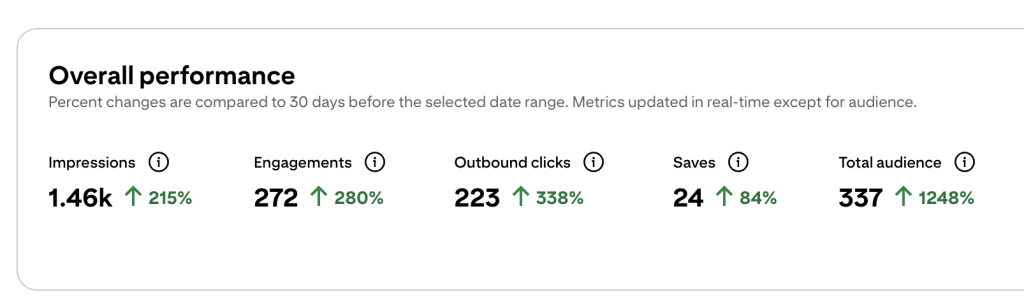
After just one month of implementing a strategic Pinterest plan, here’s what happened compared to the previous 30 days:
📈 Impressions increased by 215%
👏 Engagements increased by 280%
🎯 Outbound Clicks increased by 338%
📌 Saves increased by 84%
👀 Total Audience grew by an incredible 1,248%
Those aren’t random numbers or lucky viral moments.
They’re the result of building a strong Pinterest foundation, optimizing the account correctly, targeting the right keywords, creating strategic pin designs, and consistently publishing content Pinterest wants to show users.
Now imagine where those numbers could be after six months or even a year of consistent Pinterest strategy. MIND YOU, this is the SLOW season on Pinterest. We like to call it the “Summer Slump”
Why Hiring a Pinterest Strategist Is an Investment, Not an Expense
It’s easy to look at Pinterest management as another monthly bill.
I see it differently.
When you invest in a Pinterest strategist, you’re investing in more time, more visibility, and more opportunities to grow your business.
You’re no longer spending hours trying to keep up with Pinterest updates or wondering if you’re using the right keywords. Instead, you have someone who is focused on growing your account while you focus on serving your clients and running your business.
And here’s something many business owners don’t realize…
For most businesses, professional Pinterest management is considered a marketing expense, which is generally tax deductible. While every business is different and you should always check with your accountant or tax professional, it can make investing in your marketing even more worthwhile.
The bottom line?
Pinterest management isn’t just about paying someone to create pins.
It’s about investing in a long term marketing strategy, freeing up valuable time, and partnering with someone who knows how to turn Pinterest into a consistent source of website traffic.
When you look at it that way, the question isn’t:
“Can I afford to hire a Pinterest strategist?”
It’s:
“Can I afford not to?”
Ready to Stop Guessing and Start Growing?
If you’ve made it this far, chances are you’re serious about growing your business with Pinterest.
The real question is…
Do you want to keep spending your evenings trying to figure out Pinterest, or would you rather spend that time growing your business while someone else handles it for you?
For nearly 11 years, I’ve helped bloggers, content creators, ecommerce businesses, coaches, service providers, and major brands turn Pinterest into a reliable source of long term traffic. From helping small businesses increase website visitors to working with brands like Target, Home Depot, Sephora, and Dunkin’, I’ve learned that Pinterest success isn’t about luck. It’s about having the right strategy.
When you work with me, you’re not hiring someone to simply schedule pins.
You’re partnering with someone who will:
✔ Build a Pinterest strategy customized to your business goals.
✔ Research high performing keywords your audience is actively searching for.
✔ Fully optimize your Pinterest profile, boards, and pins for SEO.
✔ Design fresh, click worthy pins that encourage website traffic.
✔ Monitor your analytics and continuously improve your strategy.
✔ Stay on top of Pinterest trends and algorithm updates so you don’t have to.
Most importantly…
I give you your time back.
Instead of spending hours trying to figure out Pinterest, you can focus on serving your clients, creating content, launching products, or simply enjoying a little more freedom in your business.
As a bonus, every new monthly management client receives a FREE Pinterest Account Audit and SEO Optimization(a $150 value).
Before I ever create your first pin, I’ll identify what’s holding your account back, optimize your profile for Pinterest SEO, and build a custom strategy designed to help your account grow from day one.
My goal isn’t to chase vanity metrics.
My goal is to help you grow the numbers that actually matter:
Website Traffic
Email Subscribers
Leads
Sales
If you’re ready to stop guessing, stop wearing one more hat in your business, and finally have Pinterest working for you instead of sitting on your to do list, I’d love to help.
👉 Learn more about my Pinterest Management packages here
Let’s turn Pinterest into one of the hardest working marketing tools in your business.
Have you heard someone say, “Pinterest is dead” lately?
If I had a dollar for every time someone told me Pinterest doesn’t work anymore, I’d probably have enough to buy myself an iced coffee every day for a month…or at least pay for my Canva subscription for a while.
Usually, those comments come from someone who tried Pinterest for a few weeks, pinned a handful of graphics, didn’t see instant results, and decided it was time to call it quits.
Sound familiar?
The truth is, Pinterest isn’t dead. It’s just changed.
And honestly, that’s not a bad thing.
Before We Dive In…
Hi! I’m Megan, and I’ve been working in Pinterest marketing since 2014. Over the years, I’ve watched Pinterest evolve from a simple inspiration platform into one of the most powerful visual search engines on the internet. I’ve seen countless algorithm updates, feature changes, best practices come and go, and just about every “Pinterest is dead” headline you can imagine.
Throughout that time, one thing has remained true: businesses that adapt and use Pinterest strategically continue to see incredible results.
I’ve had the opportunity to work with everyone from small bloggers looking to grow their website traffic and email lists to developing Pinterest strategies for well known brands like Target, Ulta, Home Depot, Lowe’s, and Sephora. No matter the size of the business, the goal is always the same: getting your content in front of the right audience and turning Pinterest into a reliable source of long term traffic.
So, is Pinterest still worth it in 2026?
Absolutely.
Let’s talk about why.
Why Do So Many People Think Pinterest Doesn’t Work Anymore?
Honestly, I get asked this question all the time.
Usually it starts with something like, “I used to get so much traffic from Pinterest, but now it’s almost nothing.” Or, “I tried Pinterest for a few months, and it just didn’t work.”
And I get it. If you’ve watched your traffic dip or heard other business owners say Pinterest is “dead,” it’s easy to assume it’s just not worth the effort anymore.
But here’s the thing…
Pinterest isn’t broken. The strategy is.
Pinterest has changed a lot over the last several years. If you’re still using the same tactics that worked in 2018 or even 2020, there’s a good chance you’re not going to see the results you used to.
The platform is smarter now. It understands keywords better, rewards high quality content, and focuses on showing users the most relevant pins based on what they’re searching for.
In other words, Pinterest has grown up.
The good news? That’s actually a huge opportunity for businesses that are willing to adapt. While some people gave up because their old strategies stopped working, others updated their approach and continued to grow.
That’s why I always tell my clients not to chase Pinterest hacks or quick fixes. Instead, we focus on building a solid foundation with SEO, fresh content, and a strategy that continues to work long after a pin is published.
Pinterest Is Still One of the Best Places to Get Long Term Traffic
Here’s what makes Pinterest different from almost every other marketing platform.
Most social media platforms are designed to keep people on their platform.
Pinterest is designed to help people discover your content.
Think about it…
When someone opens Instagram, they’re usually scrolling to pass the time.
When someone opens TikTok, they’re looking to be entertained.
But when someone opens Pinterest, they’re searching with a purpose.
They’re planning a vacation.
Looking for a dinner recipe.
Researching home renovation ideas.
Shopping for the perfect outfit.
Learning how to start a blog.
Or searching for the exact product or service you offer.
That means Pinterest users are already in discovery mode. They’re actively looking for answers, ideas, and solutions, which makes them much more likely to click through to your website.
And here’s my favorite part…
A post on Instagram might get attention for a day or two.
A Facebook post may last a little longer.
But a well optimized Pinterest pin can continue bringing traffic to your website for months or even years.
I’ve seen pins continue generating clicks long after I completely forgot I created them. That’s the beauty of evergreen content. Instead of constantly chasing the next viral post, Pinterest allows your content to keep working for you behind the scenes.
One of my newer Pinterest management clients saw their outbound clicks increase by more than 800% in just six weeks after we optimized their account and implemented a new Pinterest strategy. Even more exciting, their website sales increased by 300% during that same timeframe.
Now, does every client see results exactly like that? Of course not. Pinterest isn’t an overnight success story, and I’d never promise that. But it does show what’s possible when you combine a solid strategy with consistency.
That’s one of the biggest reasons I still recommend Pinterest to bloggers, small businesses, ecommerce stores, and service providers in 2026.
So, What Actually Works on Pinterest in 2026?
If you’re hoping I’ll tell you there’s a secret Pinterest hack that will send millions of visitors to your website overnight…I’m sorry to disappoint you.
(If I ever find that button, trust me, I’ll let you know.)
The truth is that Pinterest success comes from doing the basics really well and staying consistent.
Here are the things that matter most in 2026:
1. Pinterest SEO
Pinterest is a search engine, which means keywords matter. Using the right keywords in your profile, board titles, board descriptions, pin titles, and pin descriptions helps Pinterest understand your content and show it to the right audience.
One of the first things I look at when I audit a new Pinterest account is SEO. More often than not, I find boards that haven’t been optimized in years, generic pin titles, and descriptions that aren’t helping Pinterest understand what the content is about.
Those are often some of the easiest wins to fix, and they can make a significant difference over time.
2. Fresh, High Quality Content
Pinterest wants to show users new, helpful content. Creating fresh pins that are visually appealing and link to valuable content gives your account more opportunities to be discovered.
3. (this is a BIG ONE) Consistency
You don’t need to pin 50 times a day anymore. In fact, I’d rather see someone publish 7 to 10 high quality pins consistently each week than disappear for a month and then upload a hundred all at once.
4. Understanding Your Audience
One of the biggest mistakes I see is businesses creating content they want to share instead of content their audience is actually searching for. The best Pinterest strategy starts with understanding what your ideal customer is looking for and creating content that answers those searches.
5. Patience
This is probably the hardest one.
Pinterest isn’t usually an overnight success story, and honestly, that’s one of the reasons I love it. You’re building an evergreen library of content that can continue working for your business long after you hit publish.
The businesses that stick with Pinterest and focus on long term growth are almost always the ones that see the best results.
What I’ve Learned After More Than a Decade in Pinterest Marketing
After more than a decade working in Pinterest marketing, my answer is simple…
Yes.
Pinterest is still worth it in 2026.
Not because it’s some magical traffic machine, but because it connects the right content with the right people at the right time.
I’ve worked with bloggers just trying to get their first 100 email subscribers, ecommerce stores looking to increase product sales, and major brands that wanted to expand their reach. While every business has different goals, the accounts that see the best results all have a few things in common.
They have a clear strategy.
They understand their audience.
They create helpful content.
And they stay consistent.
One thing that still surprises me is how many businesses think they need to create more content when, in reality, they often just need to make their existing content easier for Pinterest to understand.
Sometimes a few strategic changes to an account can make a bigger impact than publishing dozens of new pins.
I’ve also learned that success on Pinterest has very little to do with luck. The accounts that continue to grow are the ones with a strategy behind every pin they publish. They’re creating content their audience is actually searching for, using keywords intentionally, and showing up consistently. That’s what separates the accounts that slowly fade away from the ones that continue bringing in traffic month after month.
That’s why one of the first things I do with every new Pinterest management client is perform a complete account audit. Before we ever start creating new content, I want to understand what’s working, what’s holding the account back, and where the biggest opportunities for growth are.
Because in my experience, the businesses that get the best results aren’t necessarily the ones working the hardest. They’re the ones working with a strategy.
Ready to Stop Guessing and Start Growing on Pinterest?
If you’ve made it this far, hopefully one thing is clear…
Is Pinterest still worth it in 2026? Without question, YES.
The platform isn’t dead. It has simply evolved.
The businesses seeing the best results today aren’t relying on outdated tactics or hoping one pin magically goes viral. They’re using a strategy built around Pinterest SEO, consistency, and creating content their audience is actively searching for.
The good news? You don’t have to figure it all out on your own.
If you’d rather spend your time running your business instead of researching keywords, designing pins, tracking analytics, and keeping up with Pinterest’s latest updates, I’d love to help.
When you become a monthly Pinterest management client, I handle everything needed to help your account grow, including:
Complete Pinterest account optimization
Keyword and SEO research
Custom branded pin designs
Pin scheduling and publishing
Monthly analytics and performance reporting
Ongoing strategy adjustments based on what’s working
As a bonus, all new monthly management clients receive a FREE Pinterest Account Audit and SEO Optimization (a $150 value). Before we ever begin managing your account, I’ll take a deep dive into your existing Pinterest profile, identify opportunities for growth, optimize your account for search, and create a customized roadmap for long term success.
NOTE: I intentionally take on a limited number of monthly management clients so I can give each account the attention it deserves. If you’re interested in working together, I recommend reaching out before my current opening is filled.
Whether you’re a blogger, online business owner, ecommerce shop, or service provider, my goal is simple: to help you turn Pinterest into a consistent source of website traffic that continues working for your business long after each pin is published.
Ready to grow your Pinterest account without adding one more thing to your already full to do list?
👉 Visit my Work With Me page HERE to learn more about my Pinterest Management Services. I’d love to help your business grow!
We use cookies to ensure that we give you the best experience on our website. If you continue to use this site we will assume that you are happy with it.